



European age-tech has a B2B closing problem. Average sales cycle: 4.7 months. Average decision-makers per care home dossier: 6. Conversion rate plateau: 8.9%. The market opportunity is real — silver economy B2B is growing fast — but the commercial architecture required to capture it is more complex than most age-tech founders anticipate. Here is the go-to-market strategy that turns this complexity into a predictable pipeline.
Real market mapping: age-tech B2B in Europe
France alone counts over 7,500 care homes (CNSA data 2023), 580 social housing managers operating senior residences, and around forty mutual insurers and provident organisations active in the dependency sector. These three verticals have radically different purchasing cycles, budgets and decision-making processes — conflating these targets in a single commercial sequence is the most common error observed in age-tech scale-ups we work with.
European age-tech has over 120 active startups in France, from fall sensors to care coordination platforms, via digital social connection tools. Players illustrate three distinct go-to-market models: direct sales to private operators, service franchise models, and deployment via GPs. Identifying which of these models applies to your solution determines your entire acquisition strategy.
The most overlooked segment in European age-tech go-to-market: occupational pension funds and provident institutions. These organisations collectively manage the dependency risk of millions of European retirees and are actively building digital prevention ecosystems — but are rarely targeted by age-tech startups who focus exclusively on the care home vertical. Pension fund partnerships typically have longer decision cycles (6–12 months) but higher contract values and multi-year commitments.
Navigating multi-stakeholder decision-making in care homes
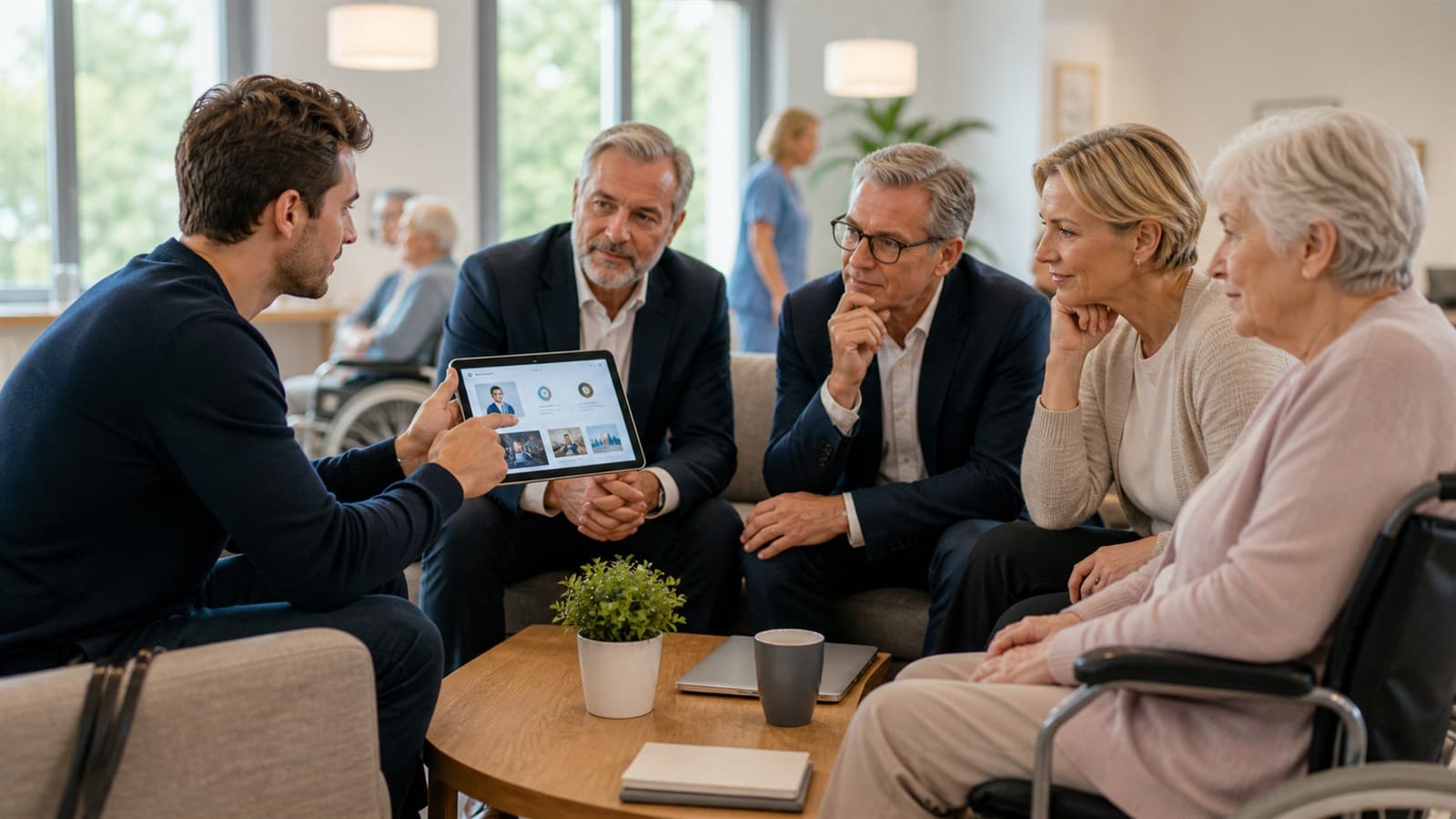
The care home purchasing decision involves an average of 6 stakeholders: the facility director (operational champion), the regional director or regional clinical director (approval authority for mid-ticket purchases), the IT director or digital coordinator (technical validation), the quality director (compliance and care quality indicator impact), the financial controller (scope envelope and ROI), and in larger groups, the group central purchasing department (final validation for standardisation decisions).
Our operational recommendation: initiate outreach via the facility director with an immediate ROI argument (fall rate reduction, HAS inspection score improvement, care worker time saved), then activate the care quality coordinator (IDEC equivalent) in the following week with field evidence — usage data, pilot studies, patient outcome verbatims. The IT director must be integrated from the demonstration phase to prevent a technical veto at the contract stage. For more on identifying these profiles, our article on B2B prospecting in care homes details the data sources and tailored sequences.
The critical mistake: treating the facility director as the final decision-maker and submitting a commercial proposal before the other stakeholders are aligned. 62% of age-tech sales cycles that stall at the 'proposal submitted' stage do so because the IT director or quality director was not brought in early enough. Map stakeholders before the first meeting — not after the second.
Outreach strategies by age-tech vertical
Connected safety devices (fall detection, GPS, alarms): the most mature sub-segment. Decision-makers: operations directors and regional purchasing directors in care home groups, SAAD network managers. Key value driver: reduction in fall-related incident reporting time and improvement in CNSA quality indicators. Best outreach channel: email sequences anchored in inspection compliance data, followed by LinkedIn for warming. Average sales cycle: 3.2 months.
Care coordination and digital health platforms: longest sales cycles (5.7 months on average) but highest ACV (audit-based scope depending on scope). Decision-makers: IT directors, chief medical officers, regional digital health transformation managers. Required: ASIP Santé certification for systems handling health data in France. Outreach must lead with interoperability references and NHS / Cofinancement credentials.
Digital social connection and cognitive stimulation tools: fastest-growing sub-segment post-COVID. Decision-makers: activities directors, quality coordinators. Shorter decision cycles (2.1 months), lower ACV (audit-based scope), high volume potential. Best suited to self-serve or product-led growth models with inside sales for mid-market accounts.
Home automation and smart home for ageing in place: most complex go-to-market. Multiple channels: direct to consumer, via domiciliary care operators, via local authority grants programmes, via housing associations. B2B focus: social housing operators with senior residence stock (580 organisations in France), telecare operators adding smart home as an upsell.
The 90-day go-to-market sprint for age-tech
Days 1–30 — ICP sharpening and database build: identify your highest-converting segment from any existing pilots or beta deployments. Build a prospecting database of 500–800 decision-maker contacts using FINESS registry, LinkedIn Sales Navigator and sector directories. Configure AI scoring on 8–10 criteria specific to your sub-vertical. Write two sequence variants (care home vs. domiciliary care) and validate with two native sector reviewers.
Days 31–60 — First wave launch and learning: deploy the first 200-contact wave, measure open rates, reply rates and objection patterns. The objections you receive in the first 30 days are your product-market fit radar — they tell you exactly what your value proposition is missing for each stakeholder type. Iterate the sequences based on observed data, not assumptions.
Days 61–90 — Scale and segment doubling: with validated sequences, scale to 400–600 contacts/month. Add the second stakeholder tier (IT directors, quality coordinators) to accounts where the first contact is warmed. Start booking multi-stakeholder demonstrations rather than single-contact discovery calls — this accelerates the decision cycle by 30–40%.
Age-tech commercial partnerships: a growth multiplier
The fastest-growing age-tech companies in Europe use distribution partnerships rather than — or in addition to — direct sales. Three partnership models are commercially proven: OEM partnerships with telecare operators (your technology embedded in their product offering, distributed to their 1,200+ care home clients without a per-facility sales cycle), integration partnerships with care management platforms (EHR / care record systems used in 80%+ of French care homes — becoming a listed integration multiplies your distribution reach by an order of magnitude), and regional authority framework contracts (a public tender win in one region opens the entire region's care facility ecosystem simultaneously).
Pursuing these partnership channels requires a different outreach approach than direct sales. Partnership decision-makers at telecare operators or EHR platforms are business development directors and product directors, not care operations directors. The value proposition is commercial (incremental revenue or ecosystem strengthening) not clinical. Our AI lead generation methodology adapts to this context by building separate ICP profiles and sequence libraries for partnership outreach versus direct sales outreach.
Every month without a lead machine is revenue handed to your competitors. 30 min to see the gap.
See B2B lead generation